Scientists use imaging to monitor how tumours consume glucose
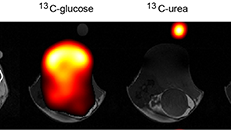
Scientists in the Brindle lab have developed a way to image how tumours use glucose, which could be used to monitor tumour response to treatment in the clinic.
The research was published on Sunday in Nature Medicine.
Tumour cells proliferate rapidly, and consume much more glucose than healthy tissues. According to researcher Tiago Rodrigues, “…a higher consumption of glucose by a given tumour is usually correlated with poor prognosis and with increased tumour aggressiveness and metastasis”. Therefore, being able to monitor the process by which tumour cells use glucose would allow researchers to monitor tumours’ response to treatment.
The team used a technique called hyperpolarisation to label the carbon atoms in glucose molecules, which produces a signal that can be recorded by the scanner. As glucose is broken down and made into new molecules, researchers can follow the labelled carbons as they are incorporated into new molecules, and therefore follow a cell’s glucose consumption and metabolism.
The researchers found that they could monitor tumour response to a chemotherapy drug. “We were able to show that the drug etoposide was damaging the cancer cells (in a lymphoma model) at a very early stage of treatment, because the damaged cancer cells don’t convert the glucose to other products so efficiently” says Rodrigues.
The hyerpolarised MRI technique also has an advantage over other imaging techniques as you can see small differences in tumour metabolism, which might be missed by other imaging techniques. “This [technique] could be particularly important to detect and to assess early treatment response in those tumours where FDG-PET shows poor contrast, such as those in brain and prostate”, Rodrigues says, adding that another advantage of the method is that “it does not use ionising radiation, so repeated measurements can be made during treatment”.
Related News
See all news-

In Memoriam: Professor Greg Hannon (1964–2026)
9th April 2026
It is with profound sadness that we share the news of the passing of Professor Greg Hannon, who led the Cancer Research UK Cambridge Institute for over eight years.
Find out more -
Most detailed map of breast tissue changes reveals role of menopause in cancer susceptibility
31st March 2026
Scientists have created the most detailed map to date, comprising over 3 million cells, showing how breast tissue changes as women age – including dramatic changes during menopause.
Find out more -
Hannon Group joins global team to decode cancer’s dark proteome
4th March 2026
Prof Greg Hannon and his group joins global Cancer Grand Challenges team taking on the dark proteome challenge.
Find out more