Discovery opens up possibility of slowing cancer spread
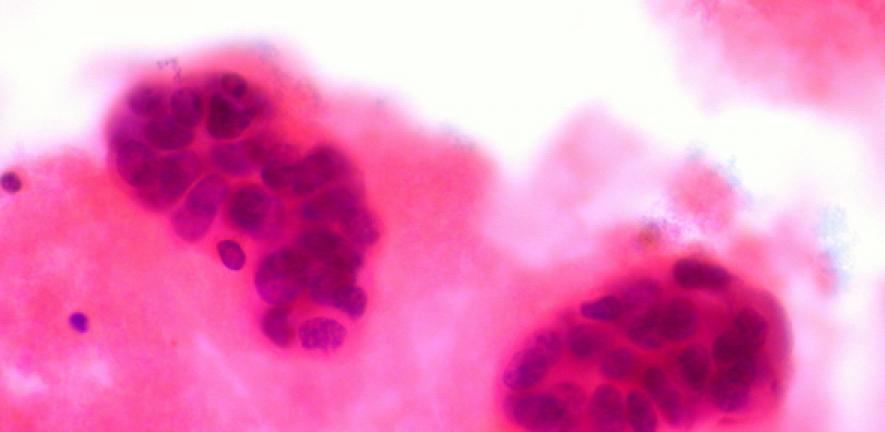
A trawl through a library of more than 50,000 ‘small molecules’ has identified a potential candidate to inhibit the spread of cancer cells throughout the body.
Reported today in the journal Nature Communications, the molecule targets a mechanism of tumour development that had previously been considered ‘undruggable’– in other words, extremely difficult, if not impossible, to target with a drug – and could open the door to further promising new candidates.
The cells in our body go through a continuous process of growth, division and death, but when this process goes awry it can lead to uncontrolled cell growth and the development of tumours. Unchecked, this growth first manifests as a localised tumour, but eventually the cancer will ‘metastasise’, invading surrounding tissues and organs. Over nine out of ten cancer deaths are attributable to such progression.
However, even in a sick patient, the vast majority of the body’s 50 trillion cells maintain accurate control over processes like growth and division for a lifetime. This process is orchestrated by proteins known as ‘transcription factors’ that instruct DNA in the cells to produce specific proteins needed by the cell at specific times. A transcription factor searches for specific genes on DNA and once it finds them, turns them on as needed. Common perturbations in cancer, such a mutation in the gene that produces a transcription factor, or an over-production of the factor itself, can disrupt the proper functioning of this network.
Recently, cancer biologists discovered that one particular transcription factor called FOXM1 is vastly over-abundant in many diverse types of cancers including breast, lung, ovarian and head and neck carcinomas. Importantly, the amount of FOXM1 present in a given tumour was shown to correlate with both the stage of the disease and the severity of prognosis, with high levels of FOXM1 indicative of advanced disease and poor patient outcome.
FOXM1 has been shown to control the activity of many gene targets known to play a role in the development and spread of cancer. However, transcription factors have long been considered ‘undruggable’.
Researchers from the Department of Chemistry at the University of Cambridge and the Cancer Research UK Cambridge Institute hypothesized that FOXM1 might represent a novel target for next-generation chemotherapeutics and developed a tool to identify potential ‘small molecules’ that could inhibit the action of the transcription factor – like finding the correct key to fit into switch and deactivate the transcription factor.
Mike Gormally, a PhD student at the University of Cambridge, explains: “Transcription factors bind a bit of DNA, but targeting the interface between DNA and the protein is difficult. It’s often much larger than can be targeted with a ‘small molecule’, and lacks well defined cavities for the drug to latch onto. That doesn’t mean this is impossible, but it does make rational design of drugs much more difficult: it’s hard to pick a feature out and say, if we can drug this feature, we will inhibit this transcription factor.”
In collaboration with the National Center for Advancing Translational Sciences, a division of the US National Institutes of Health (NIH), the team used high throughput screening tools to probe a library of 54,211 small molecules and identified a promising candidate that binds to FOXM1 protein and blocks it from binding its target DNA. In human breast cancer cells, this compound, FDI-6, suppresses the genes targeted by FOXM1, halting cancer cell proliferation. Whilst not a drug itself, the molecule provides a tool to better understand how FOXM1 drives disease, and indicates promising potential for designing drugs to target FOXM1 in the clinic in future work.
Professor Shankar Balasubramanian, a Wellcome Trust Senior Investigator, says: “With this new compound, we have found for the first time a tool that can modulate FOXM1 in a living cell. This gives us the ability to study what happens when we disrupt the activity of the transcription factor and begin to ask questions such as whether this will slow down the progression of fast growing tumours and whether other mechanisms kick in and compensate.”
Related News
See all news-

In Memoriam: Professor Greg Hannon (1964–2026)
9th April 2026
It is with profound sadness that we share the news of the passing of Professor Greg Hannon, who led the Cancer Research UK Cambridge Institute for over eight years.
Find out more -
Most detailed map of breast tissue changes reveals role of menopause in cancer susceptibility
31st March 2026
Scientists have created the most detailed map to date, comprising over 3 million cells, showing how breast tissue changes as women age – including dramatic changes during menopause.
Find out more -
Hannon Group joins global team to decode cancer’s dark proteome
4th March 2026
Prof Greg Hannon and his group joins global Cancer Grand Challenges team taking on the dark proteome challenge.
Find out more