$1M to advance AI powered personalised ovarian cancer care
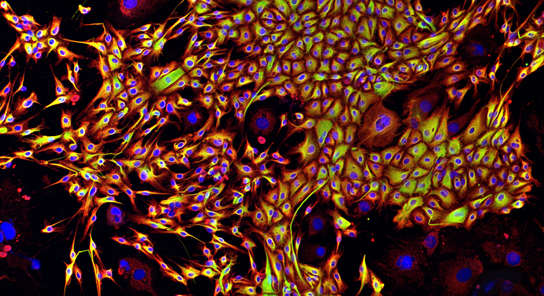
Researchers from our Brenton Group are part of an international team awarded the Global Ovarian Cancer Research Consortium’s inaugural AI Accelerator Grant.
The collaboration brings together researchers from the UK, Canada, Australia and the United States to understand if artificial intelligence (AI) can improve how survival and treatment responses are predicted in ovarian cancer.
Using the $1 million global research award, plus an additional $1 million in compute support from Microsoft’s AI for Good Lab, the team will analyse one of the largest and most comprehensive international collections of ovarian cancer data ever assembled. They’ll integrate tumour samples, clinical records, immune response, genetic information, and lifestyle factors from thousands of patients across international research institutions.
Using fine-tuned AI models, the researchers will then analyse the data collectively to identify patterns in survival and treatment response that current tools cannot detect. By improving how patients are matched to treatments and clinical trials, the project , and ultimately help improve survival outcomes for women with ovarian cancer.
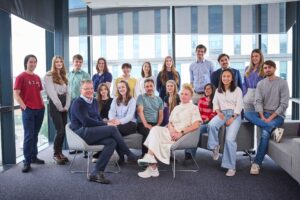
Prof James Brenton and his research group
“Ovarian cancer survival rates can improve if the best minds work together at a global scale” says Cary Wakefield, Chief Executive of Ovarian Cancer Action. “Clinicians today have limited ability to predict how an individual patient’s cancer will behave or which therapies will be effective. By connecting global data from thousands of women, powered by Microsoft AI, we will pinpoint how each tumour responds to treatment, with the potential to dramatically change treatment for the 7,500 women diagnosed in the UK every year.”
The research team behind the project is a group of experts from four countries, representing epidemiology, molecular oncology, artificial intelligence, and clinical medicine:
Professor James Brenton, Professor of Ovarian Cancer Medicine, Senior Group Leader at the Cancer Research UK Cambridge Institute and Honorary Consultant in Medical Oncology, University of Cambridge, United Kingdom.
Dr. (Celeste) Leigh Pearce, Associate Professor and Associate Chair, Department of Epidemiology, University of Michigan, United States
Professor Susan Ramus, Professor in the School of Clinical Medicine and Lead, Molecular Oncology Group, University of New South Wales, Australia
Dr. Ali Bashashati, Director of Artificial Intelligence Research, Ovarian Cancer Research Program (OVCARE), University of British Columbia, Canada
“Ovarian cancer is an incredibly complex disease,” says Professor James Brenton, the UK lead researcher on the project. “Ongoing DNA changes in the cancer mean it can become resistant to chemotherapy, and its unique pattern of spread and ability to prevent normal immune responses, can leave our immune system unable to fight the cancer. These barriers make it very difficult to treat effectively.
“Our aim is to use advanced machine learning (AI) to make sense of this multi-scale complexity to develop new clinical tools that are urgently needed to more accurately predict survival and guide clinical decision-making.”
“I feel very proud to have contributed as a patient representative in this global, patient-informed initiative,” says Andrea Raman, a UK patient diagnosed with Stage 4 ovarian cancer. “It is reassuring to see scientists and patients working side by side to guide innovation. AI represents genuine hope – this initiative signals a future where that hope is shaped by both science and lived experience, for women worldwide.”
The AI Accelerator Grant was first announced in 2025 as the inaugural initiative of the Global Ovarian Cancer Research Consortium, marking a new, collaborative approach to accelerating ovarian cancer research using artificial intelligence. The international call for grant applications attracted 21 proposals from collaborative teams worldwide, underscoring the interest and potential in this line of research.
“New discoveries are urgently needed to unlock lifesaving treatments for ovarian cancer,” said Juan Lavista Ferres, Microsoft Chief Data Scientist and Director of Microsoft’s AI for Good Lab. “This work demonstrates what becomes possible when deep scientific expertise is paired with cutting‑edge AI. By equipping leading researchers around the world with advanced AI tools and computing resources, we can accelerate their critical efforts that have the potential to save lives.”
Formed in 2024, the Consortium unites four leading ovarian cancer research organisations from around the world – Ovarian Cancer Research Alliance (United States), Ovarian Cancer Research Foundation (Australia), Ovarian Cancer Canada, and Ovarian Cancer Action (United Kingdom). Together, the partners are combining resources, data, and determination to accelerate progress in a disease where survival rates have seen limited improvement for decades.
Related News
See all news-
Most detailed map of breast tissue changes reveals role of menopause in cancer susceptibility
31st March 2026
Scientists have created the most detailed map to date, comprising over 3 million cells, showing how breast tissue changes as women age – including dramatic changes during menopause.
Find out more -
Hannon Group joins global team to decode cancer’s dark proteome
4th March 2026
Prof Greg Hannon and his group joins global Cancer Grand Challenges team taking on the dark proteome challenge.
Find out more -
Professor Sir Steve Jackson elected as a fellow of the American Association for Cancer Research
16th February 2026
Senior Group Leader Sir Steve Jackson has been elected as a Fellow of the American Association for Cancer Research Academy in the Class of 2026.
Find out more