Improving the experience of patients living with pancreatic cancer
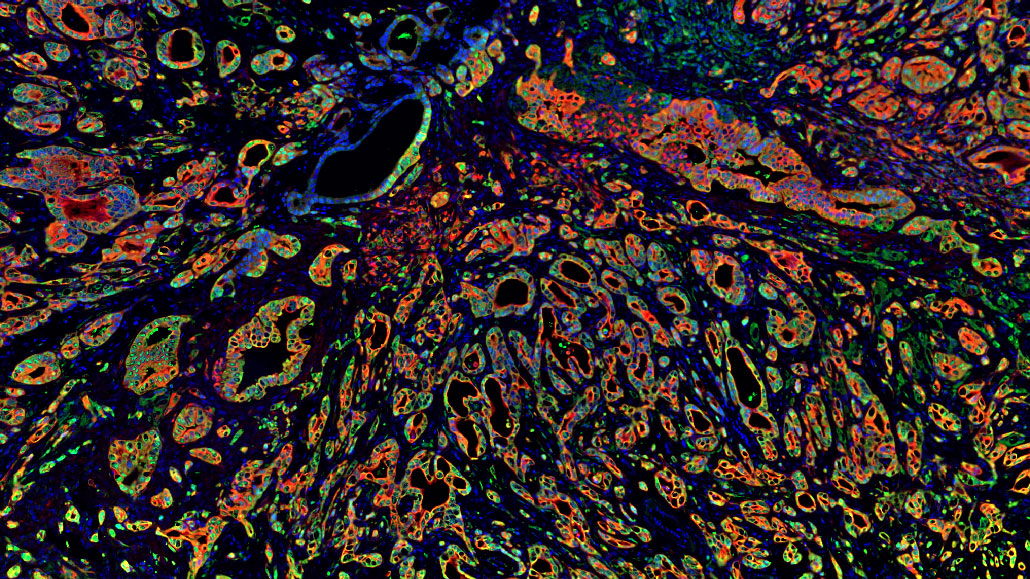
A discovery made in our Miller Lab is allowing researchers and clinicians to trial a drug to improve patients’ quality of life and the effectiveness of pancreatic cancer treatments.
Pancreatic cancer is a difficult disease to treat therapeutically. It is usually diagnosed late when it has spread beyond the pancreas in a process called metastasis. At this point, the life expectancy for people diagnosed with the disease is less than a year. Where treatment is possible, it often comes in the form of an intensive chemotherapy course with significant side effects, affecting patients’ quality of life.
VP-002 is a repurposed drug designed to block a protein called CCR1 that plays a key role in helping a pancreatic cancer tumour to grow. This discovery came about when researchers took a step back and looked at how these tumours are structured. Tumours are more than a collection of cancer cells, they contain many cells like those that make up connective tissue, called fibroblasts, and immune cells such as macrophages. These “normal”a cells communicate with cancer cells and help the tumour to grow. In a pancreatic cancer tumour, CCR1 is a key player in how cancer and macrophages (non-cancer cells) communicate.
In November 2025, VP-002 was approved for a clinical trial, known as CRISTAL-APC, which aims to include 120 patients across 15 hospitals. It will run in two phases. The first will look at different doses of VP-002 and chemotherapy to identify which is the safest and most effective combination for the desired result. In the second phase, the combination of chemotherapy and VP-002 will be compared against the current standard treatment of chemotherapy alone. If successful, larger studies will be needed to prove whether VP-002 should become a standard treatment for late-stage pancreatic cancer.
By using VP-002 to weaken the cancer, doctors hope to be able to use a lower dose of chemotherapy. For patients, this could mean fewer side effects, while still being just as effective at treating cancer.
CRISTAL-APC is led from Cambridge University Hospitals NHS Foundation Trust (CUH) under Chief Investigator Dr Bristi Basu of the Cancer Research UK Cambridge Centre, and the initial research underpinning it was led by our Institute’s Dr Tony Wu, Dr Michael Gill and supported by our Pre-Clinical Genome Editing Core Facility.
Impact
See all case studies-

Increasing the uptake of genetic testing with ovarian cancer patients
The DEMO project aims to increase genetic testing for ovarian cancer patients by addressing language barriers and providing tailored resources.
Find out more -

Next generation DNA sequencing
The development of Next Generation Sequencing technology has reduced the time and cost of sequencing DNA.
Find out more -
Transforming cancer treatment with Olaparib
Olaparib has significantly impacted patient outcomes, with over 140,000 patients treated, reducing disease progression and death by up to 66%.
Find out more